Artificial Civilization
What kind of society do autonomous agents build?
- By
- OmniQm Research
- Year
- 2026
- Services
- Research
- Multi-agent simulation
- LLM agents
- Data visualization
- Platforms
- Simulation
- Web dashboard
- Status
- In progress
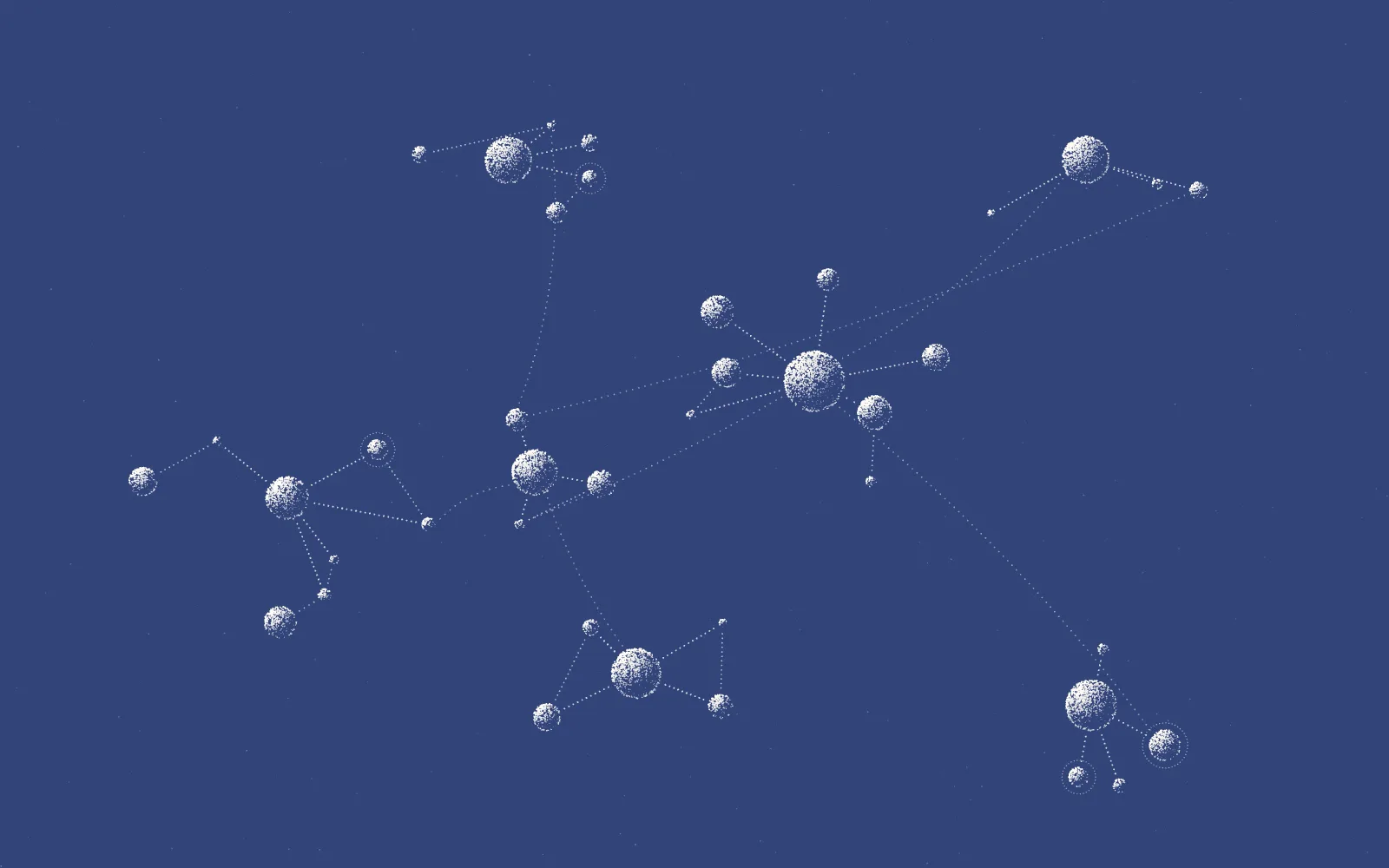
An ongoing OmniQm research project: a persistent simulated world where autonomous agents with memory, incentives, and resources live, trade, govern, and compete — built to observe what kind of society emerges when you design the rules, not the outcomes.
The question
If you give autonomous agents persistent memory, individual incentives, resources, and the ability to affect one another inside a shared, persistent world, what kind of society do they build?
Rules, not outcomes
Every agent has a personality, needs like hunger, energy, and social contact, skills, money, memory, relationships, and a reputation. Agents act on their own needs and incentives; nothing about the society itself is scripted.
Two kinds of minds
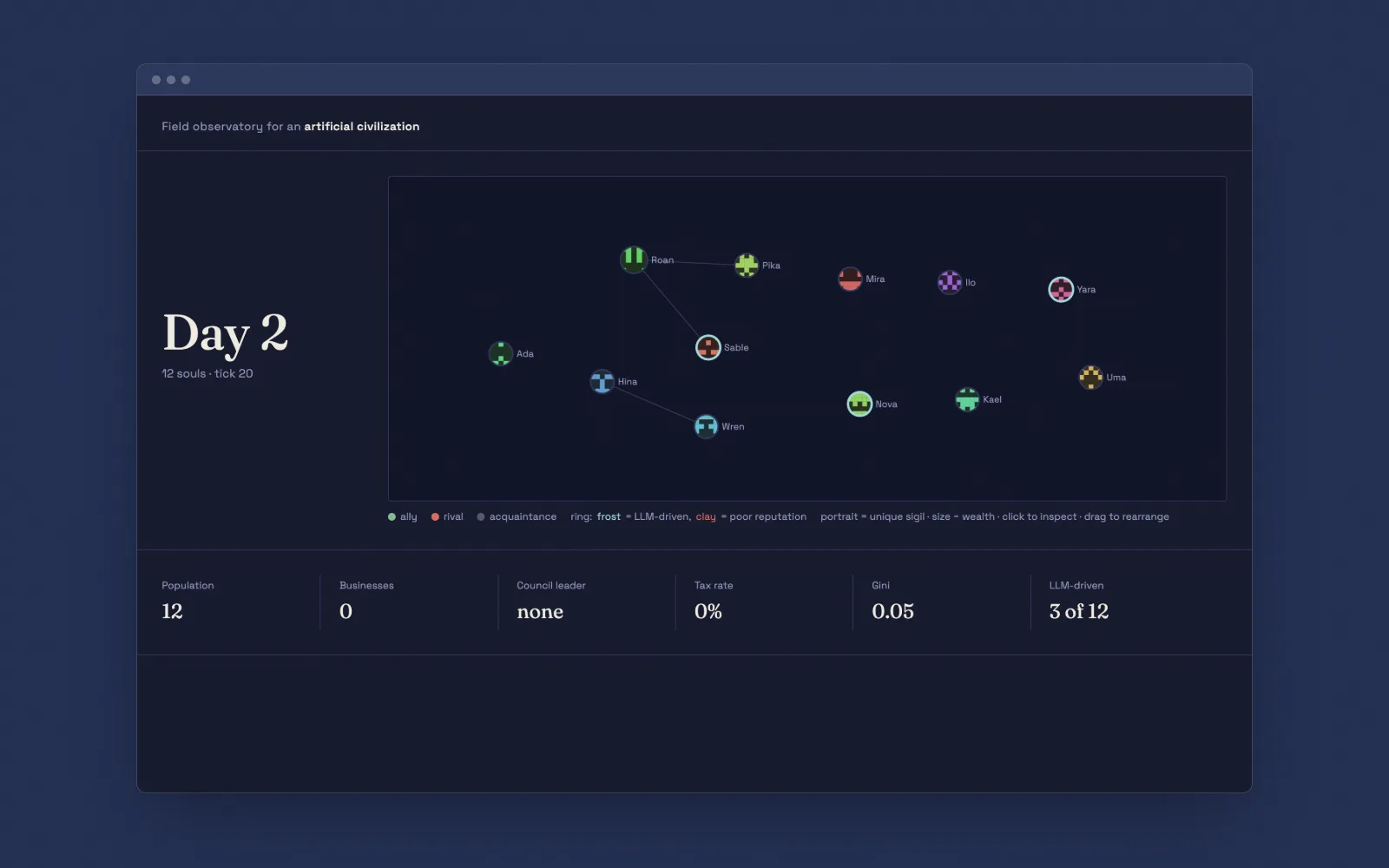
Rule-based agents score the actions open to them each tick; language-model agents decide in words. In the current configuration, 3 of the 12 founding agents are driven by a local model (Llama 3.2 via Ollama) and run side by side with the rule-based ones, so their behavior can be compared. LLM agents fall back to rules if the model fails.
An economy and a polity
Markets with supply-and-demand pricing, businesses with treasuries and wages, peer-to-peer trade negotiation, and a town council that votes on taxes and hoarding and holds elections — alongside theft, conflict, alliances, rivalries, and culture.
The Observatory
A self-contained, interactive dashboard renders a snapshot of the world: a relationship network graph, wealth, inequality, and tax charts, governance and culture panels, and an event timeline. Early runs are underway; findings will follow as the simulation matures.
- Python
- SQLite
- Ollama · Llama 3.2
- Chart.js
- D3